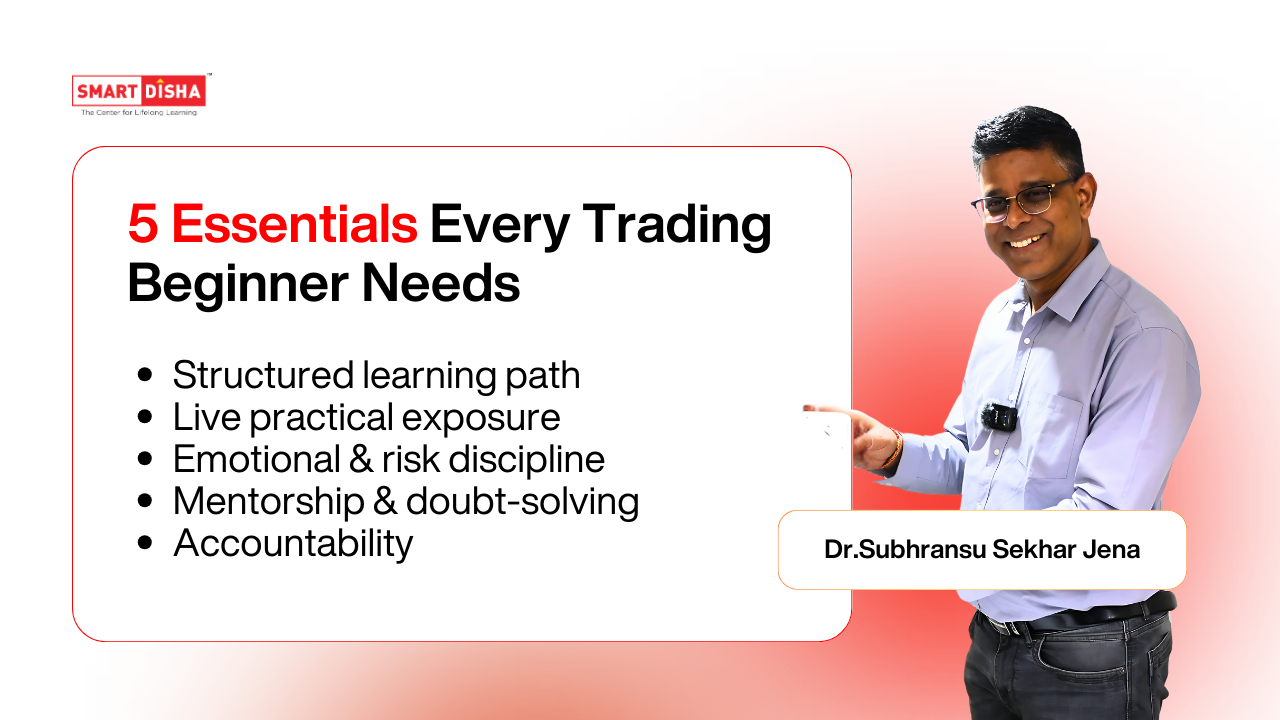

Starting to trade can feel like standing in the middle of a crowded marketplace where everyone is shouting a different tip, which is exactly why a beginner trading blueprint is so important. One person swears by indicators, another by price action, someone else says “just follow FII data,” and very quickly most beginners end up feeling lost, confused, and scared of making costly mistakes
The Smart Disha Method is built to cut through this noise and give you that beginner trading blueprint in a simple, structured form you can follow even with a full time job. Instead of random strategies, it acts like a clear roadmap so you always know what your next step is and why you are taking it
Set clear, honest goals
Before a single rupee goes into the market, pause and ask a basic question: Why do I want to trade?
- Do you want a secondary source of income?
- Are you aiming to build long‑term wealth and not depend only on salary?
- Or are you simply curious and want to understand how markets work?
Writing this down matters more than most beginners realise. Clear goals decide:
- How much capital you should start with
- Which timeframes and strategies make sense for you
- How patient you need to be with your learning curve
At Smart Disha, students are pushed to define these goals in simple sentences and revisit them every few months. This stops you from jumping into random styles just because someone on social media made a quick profit
Learn the real basics, not just fancy names
Many beginners try to skip the fundamentals and jump straight into complex indicators or options. That usually ends badly. A solid foundation includes:
- Knowing order types (market, limit, stop‑loss, bracket, etc.)
- Understanding how candlestick charts and basic chart patterns work
- Learning what support, resistance, trend, and volume really mean
- Getting a simple picture of fundamentals like earnings, debt, and valuations
The goal is not to become a PhD in finance. The goal is to understand what you are looking at on the screen so you stop relying blindly on others. Smart Disha keeps this part bite sized and practical, with examples from Indian stocks that students actually see on their own broker screens
Choose a trading style that fits your life
Not every style suits every person. A working professional with a 9–6 job simply cannot track markets tick‑by‑tick like a full‑time scalper. That’s why the Smart Disha Method forces you to match your style with your lifestyle
Common styles:
- Day trading Enter and exit within the same day. Needs time, focus, and emotional control
- Swing trading Hold positions for a few days to a couple of weeks. Good for those who can check markets briefly during the day and do analysis in the evening
- Positional trading / investing Hold for weeks, months, or longer based on trend and fundamentals
For most beginners, especially job‑holders, swing or positional trading is the most realistic starting point. You get time to think, analyse, and learn from each trade instead of panicking at every five minute candle
Build a written trading plan
A trading plan is your personal rulebook. Without it, every trade becomes an emotional decision. With it, each trade becomes just one sample in a much bigger, controlled process
A basic plan covers:
- Which instruments you trade (index, large‑caps, specific sectors)
- Clear entry rules (for example: only trade in the direction of the daily trend, enter near support with confirmation)
- Exit rules for profit and stop‑loss
- Maximum risk per trade (for example, 1–2% of total capital)
- Maximum number of trades per day or week
Smart Disha students are encouraged to keep this plan on one page. If it doesn’t fit on a page, it’s probably too complex for a beginner. The plan will evolve with experience, but you start with something simple and realistic
Practice in a safe environment first
Jumping straight into the market with full capital is like learning to drive on a highway at night. A much better path is:
- Use a paper trading or virtual trading platform to execute your rules
- Treat it seriously enter and exit exactly as you would with real money
- Track your results in a simple sheet or trading journal
This stage helps you check whether your strategy and psychology work in real‑time without the pain of real losses. You will see where you hesitate, where you exit too quickly, and where your rules are unclear
Start small, then scale
Once you have tested your approach and understand the basics of order placement, you can enter the real market but slowly
- Start with a small portion of your capital
- Use fixed position sizes so one bad trade cannot destroy your account
- Avoid the temptation to “double up” after a loss just to recover
As you gather a track record of disciplined trades, you can gradually increase position size. The Smart Disha Method treats capital like oxygen: you never risk so much that one mistake takes away your ability to trade tomorrow
Review, reflect, refine
Improvement in trading doesn’t come from more indicators; it comes from better self awareness. That’s why reviewing your trades is part of the blueprint, not an optional extra
A simple weekly review can answer questions like:
- Did I follow my plan, or did I improvise?
- Where did I break my rules and why?
- Are there patterns in my losses (late entries, chasing moves, trading when tired)?
With Smart Disha’s guidance, beginners learn to treat losses as information, not as permanent failure. The goal is not to avoid every losing trade; the goal is to avoid repeating the same mistake again and again
Learn with a community, not alone
Trading alone in front of a screen can become mentally exhausting. A supportive community and mentors make a big difference
By joining stock market classes in Ahmedabad with Smart Disha, beginners get:
- Structured lessons instead of random YouTube hopping
- Live doubt‑clearing and real‑market case studies
- Accountability someone actually checks whether you are applying what you learned
For most people, this support is what turns trading from a confusing hobby into a serious, skill‑building journey
FAQ
Q1. What is the best way to start trading as a beginner?
Begin with clear goals, learn the fundamentals of orders and charts, and practice your rules on a simulator before risking real capital. This builds confidence and reduces costly beginner mistakes
Q2. How much money should I start with?
Start with an amount you can emotionally afford to see fluctuate and possibly lose while you are learning. The focus in the first phase should be on building skill, not on making big money
Q3. What should every beginner know before placing their first trade?
You should know your trading style, your exact entry and exit rules, and how much you are willing to lose on that trade. If any of these are unclear, you are not ready to click the buy button
Q4. How can I keep improving my trading over time?
Maintain a trading journal, review your trades weekly, and seek feedback from experienced mentors. Continuous learning through structured courses and real‑market practice helps you sharpen both your strategy and your mindset
Q5. Why do most beginners fail in trading?
Most fail because they trade without a plan, risk too much on each idea, and let emotions drive decisions. Following a clear blueprint like the Smart Disha Method dramatically reduces these risks and gives beginners a practical path to long term growth
 SEBI Registered Research Analyst