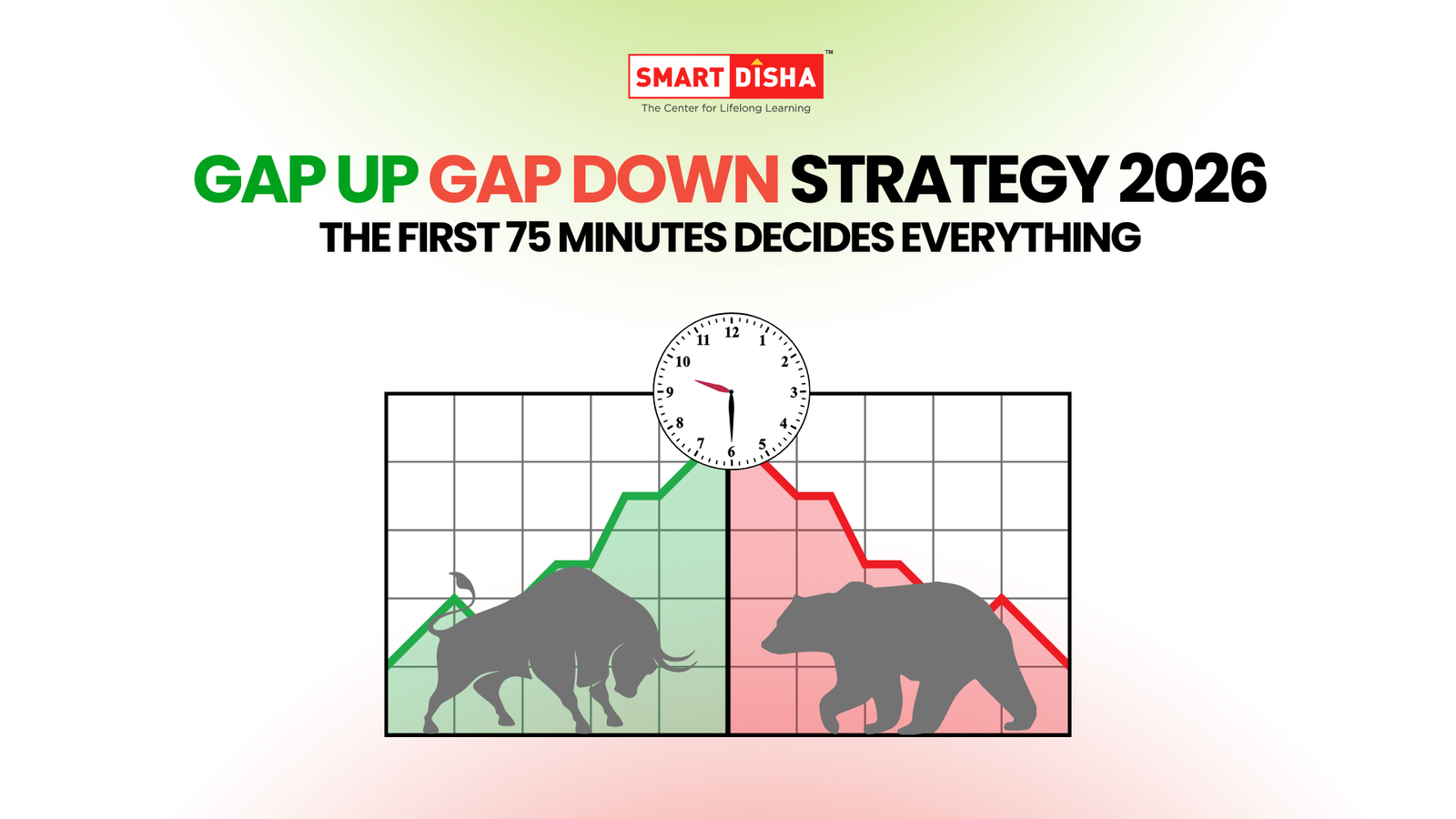
The First 75 Minutes Decide Everything
Bank Nifty frequently opens with 200–300 point gaps, and this is where most retail traders make costly mistakes. A strong gap up often triggers emotional decisions within the first few minutes of trading. Many participants rush to buy calls or puts purely based on gap direction, without understanding structure. A disciplined Gap Up Strategy, however, is never about reacting instantly it is about waiting for confirmation.
At Smart Disha Academy in Ahmedabad, we train traders to understand a core principle behind every successful Gap Up Strategy: the gap itself is not the opportunity. The real opportunity is created by how price reacts after the open. Professional gap trading depends on structure, volatility management, controlled risk, and precise timing not speed
Below are the most frequently searched questions about Bank Nifty gap trading and Gap Up Strategy execution, explained clearly and practically
1. Bank Nifty gap up 200 points calls or puts?
A strong gap up often attracts aggressive call buying in the first 5 minutes. However, large gap ups frequently see early profit booking. Instead of trading immediately, wait for price interaction with VWAP. If price fails above VWAP and forms a 5 minute breakdown structure, the probability of a pullback increases
Ideal entries generally come after 9:40–9:45 AM, once structure confirms direction. Stop loss can be placed above the gap high with a small buffer. Targets of 120–150 points are realistic in structured reversals
2. Gap down 250 points should calls be bought immediately?
Immediate entries are rarely disciplined decisions. Large gap down days often attempt partial gap fills within the first hour. The safer approach is to observe the first 15 minute range and trade only after breakout confirmation with volume support
Risk should remain controlled within a 30–50 point stop loss depending on volatility conditions
Resource: Economic Times Indices
3. Why is the first 75 minutes so important?
Historically, a significant portion of Bank Nifty’s daily range forms between 9:15 AM and 10:30 AM. This is when overnight global cues, option writer positioning, and FII activity get reflected in price action. After this window, momentum often slows down and midday sessions become range bound and trap heavy
Professional traders focus on the early session and the final hour rather than trading randomly throughout the day
Resource: TradingView Bank Nifty Chart
4. Does VWAP rejection improve gap fill probability?
VWAP acts as an institutional benchmark. On a gap up day, if price fails to sustain above VWAP and breaks down with structure, it often signals reversal pressure. Conversely, on a gap down day, reclaiming VWAP with strength can indicate upside recovery
However, VWAP alone is not enough. Candle structure and volume confirmation are essential
Resource: Groww Technical Analysis Guide
5. Which stocks lead Bank Nifty reversals?
Certain high-beta banking stocks often show directional strength before the index confirms it. Federal Bank, Axis Bank, and IDFC First Bank can sometimes lead early moves, while heavyweights like HDFC Bank and ICICI Bank confirm broader direction later
Monitoring both the index and key constituents improves directional confidence
Resource: Livemint Banking Sector News
6. Is iron condor safe after early gap range formation?
If Bank Nifty stabilizes between 9:45–10:15 AM and creates a defined range, iron condor strategies may work in sideways conditions. Wing selection typically depends on implied volatility and current price levels, often around ±150 points.
Risk-reward must be clearly defined before entry. No options strategy should be treated as guaranteed income
Resource: NSE Option Chain
7. Do most Bank Nifty gaps close by the end of the day?
Many gaps attempt partial or full fills, but not every gap closes completely. The final trading hour can offer strong directional setups, especially if the morning move remains incomplete. Intraday traders should avoid carrying unhedged positions overnight
Resource: Zerodha Varsity
8. How important are FII flows on gap days?
FII data provides context rather than certainty. A gap up combined with heavy FII selling increases downside probability, while a gap down with strong FII buying can support bounce attempts. Checking early session data before forming a bias adds an institutional layer to analysis
Resource: Moneycontrol FII/DII Data
9. What is the ideal stop loss during gap volatility?
During high volatility sessions, 5 minute candles in Bank Nifty often range between 35–45 points. A 40–50 point stop loss aligns with short term volatility structure. Risk per trade should remain within 1% of total capital to ensure long term survival
Resource: Business Standard Markets
10. Can a ₹5 lakh account realistically generate ₹2–3 lakh monthly from gap trading?
Theoretical calculations can look attractive, but real trading includes losing streaks, execution errors, slippage, and psychological pressure. Sustainable traders focus on disciplined percentage growth rather than unrealistic monthly targets
Resource: Economic Times Markets
Why Structured Gap Training Matters
Most traders fail on gap days because they trade without confirmation, oversize positions, ignore volatility structure, and react emotionally. Gap trading is not about speed it is about controlled execution under pressure
At Smart Disha Academy, our stock market course in Ahmedabad focus on live market structured execution, institutional VWAP logic, disciplined risk management, and capital protection techniques. The goal is not to chase every gap, but to trade only high probability setups with clarity
Gap trading rewards discipline and punishes ego. The first 75 minutes require patience, not aggression
If you are serious about learning structured Bank Nifty gap trading with proper risk control, professional guidance makes a measurable difference