
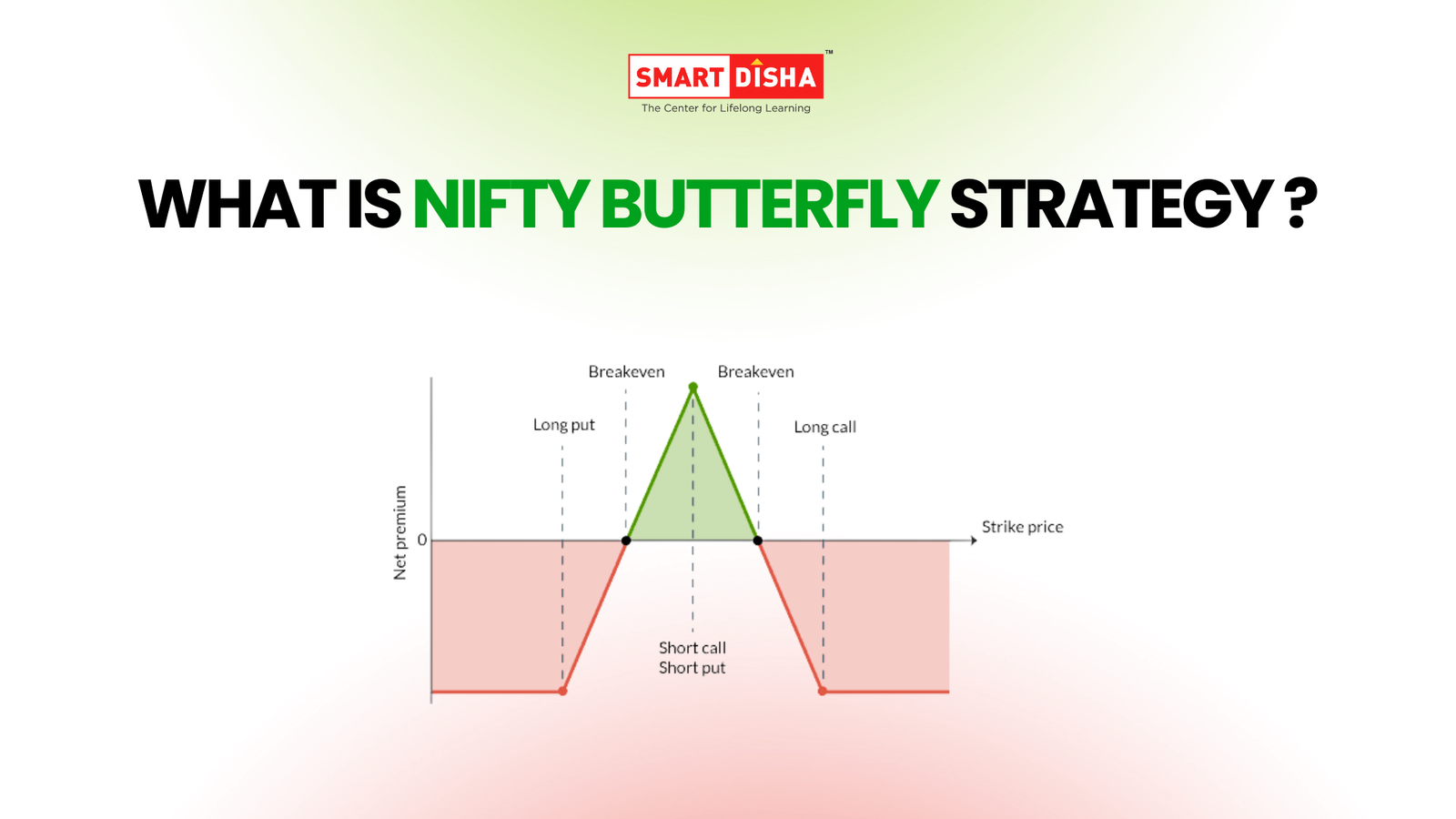
The Nifty Butterfly Strategy is a structured options spread designed for traders who expect the market to expire near a specific level. It is a limited risk, limited reward strategy that provides clarity in both profit and loss scenarios. Unlike aggressive option selling setups, the Butterfly demands precision in strike selection and disciplined execution
When used correctly, it becomes a controlled positioning tool rather than a speculative trade
What Is the Nifty Butterfly Strategy?
The most common version used in Nifty is the Long Call Butterfly. It involves three different strike prices with the same expiry:
- Buy 1 lower strike Call
- Sell 2 at the money Calls
- Buy 1 higher strike Call
This structure creates a tent shaped payoff. Maximum profit occurs if Nifty expires at the middle strike. Maximum loss is limited to the net premium paid while entering the trade
The strategy benefits from price stability, not large directional movement. If Nifty moves too far from the middle strike, profit reduces significantly
When Should You Use It?
The Nifty Butterfly Strategy works best when:
- Nifty is trading in a narrow range
- Volatility is stable or expected to decline
- Expiry is near
- A strong support or resistance level is visible
It is particularly effective during expiry week when price tends to stabilize around key levels
Avoid using this strategy during:
- Budget or RBI announcement weeks
- High volatility breakout phases
- Strong trending markets
Butterfly requires calm conditions to perform effectively
Risk and Reward Structure
Here is a simplified comparison:
| Feature | Butterfly Strategy |
| Market View | Neutral with Target |
| Risk | Limited |
| Reward | Limited |
| Profit Zone | Narrow |
| Margin Requirement | Lower than naked selling |
The strategy offers clarity. However, the profit zone is narrow, which means strike selection must be accurate
Capital Requirement
Because risk is defined, margin requirement is lower than naked selling strategies. However, traders must understand that limited risk also means limited profit.
This strategy suits traders who:
- Prefer defined outcomes
- Want structured payoff
- Avoid unlimited exposure
- Understand volatility behavior
It is not ideal for traders seeking aggressive weekly income from strong market moves
Common Mistakes
Many traders misuse the Butterfly strategy by:
- Selecting random middle strikes
- Ignoring volatility conditions
- Holding the position blindly till expiry
- Over leveraging because risk appears small
Defined loss does not mean guaranteed safety. Discipline remains essential
Risk Management Rules
- Choose the middle strike based on technical levels
- Avoid entering during high impact news weeks
- Calculate breakeven levels before entry
- Exit early if price moves aggressively away from the target
- Maintain proper lot sizing
Consistency depends on risk control, not just strategy structure
FAQ
1. Is the Nifty Butterfly Strategy profitable?
Yes, it can be profitable when Nifty expires near the middle strike and volatility remains stable. It is a precision based setup
2. What is the maximum loss in a Butterfly strategy?
Maximum loss is limited to the net premium paid while entering the trade
3. Is Butterfly better than Iron Condor?
Butterfly has a narrower profit zone and requires more precise strike placement. Iron Condor offers a wider profit range. The better choice depends on market expectation
4. Can beginners use this strategy?
Beginners should first understand option basics, payoff structures, and risk calculation before deploying multi leg spreads like Butterfly
5. When should Butterfly be avoided?
It should be avoided during strong trending markets, high volatility expansion, or major economic announcements
Final Perspective
The Nifty Butterfly Strategy is a structured, defined risk approach suitable for traders who expect price stability near a specific level. It is not designed for aggressive speculation but for controlled positioning
Options trading demands clarity in strike selection, volatility understanding, and risk discipline. Traders who want to learn structured strategies like Butterfly with proper capital management can benefit from systematic guidance. At Smart Disha, a leading stock market classes ahmedabad, the focus remains on risk first trading and disciplined execution rather than unrealistic income expectations
In trading, protecting capital is the foundation. When risk is defined and discipline is maintained, consistency becomes achievable