
In Series 1, we built a complete income statement framework by testing five profitability and growth metrics. However, a company can pass every income statement test and still be a risky investment if its balance sheet is loaded with debt.
That is exactly where the debt to equity ratio becomes the next critical checkpoint.
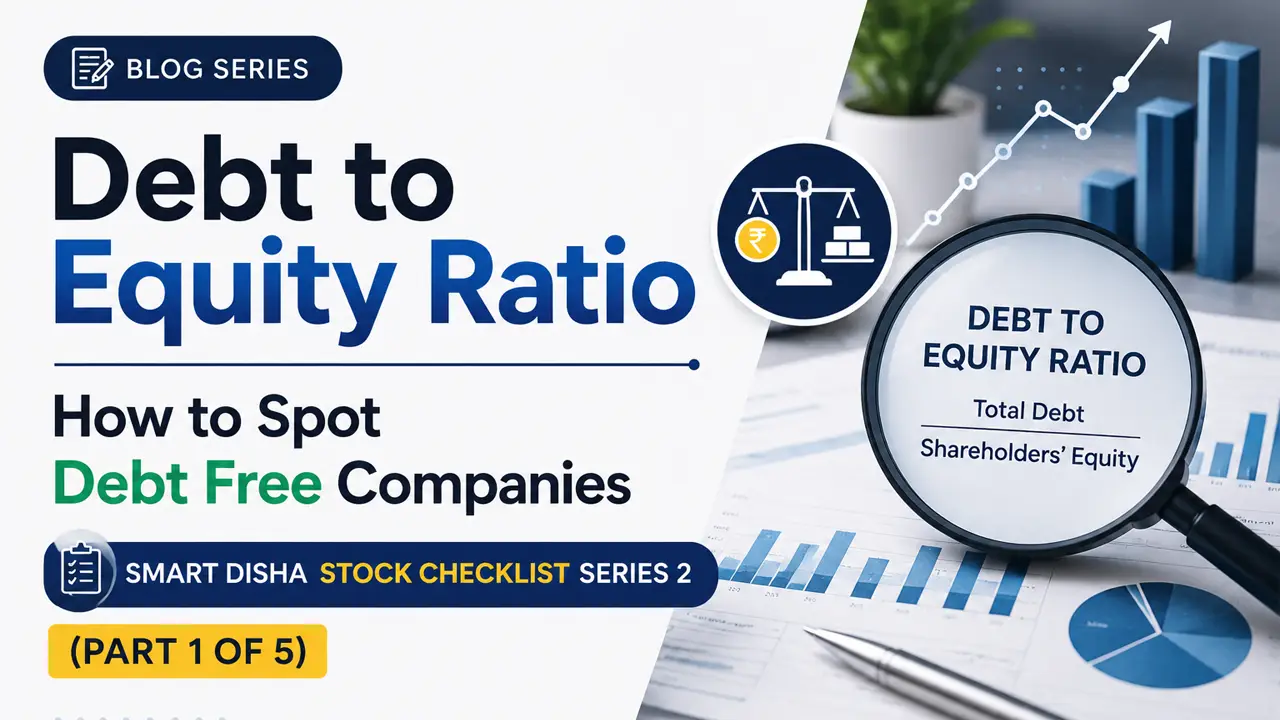
The debt to equity ratio is the first metric in Smart Disha’s Balance Sheet Checklist and it is one of the most important risk indicators every Indian investor must understand. Moreover, it directly answers the question that separates a financially strong company from a financially fragile one: how much of this business is funded by borrowed money?
In this article, which is Part 1 of our 5-part Balance Sheet Series, we explain what the debt to equity ratio means, why it should be below 0.5, and how to use it to spot genuinely debt-free companies in the Indian market.
What is Debt to Equity Ratio?
The debt to equity ratio measures how much debt a company is using compared to the equity (shareholder capital) it has. In other words, it shows whether a company is primarily funded by its own money or by borrowed money.
Formula:
Debt to Equity Ratio = Total Debt / Shareholders’ Equity
Here is a simple example:
- Total Debt: Rs. 40 crore
- Shareholders’ Equity: Rs. 100 crore
- Therefore, Debt to Equity Ratio = 0.4
This means the company has only Rs. 40 of debt for every Rs. 100 of shareholder capital. Consequently, this is a financially conservative and low-risk business from a balance sheet perspective
Why Debt to Equity Ratio Matters for Every Indian Investor
Debt is a double-edged sword for any business. On one hand, borrowing money allows a company to grow faster than it could with equity alone. On the other hand, debt comes with mandatory interest payments that must be paid regardless of whether the business is performing well or not.
Think of it this way. When business is good, a company with high debt looks profitable on paper. However, when revenues fall during an economic downturn, that same company suddenly struggles to meet its interest obligations. Furthermore, if it cannot service its debt, lenders can force the company into default or even bankruptcy.
This is precisely why the debt to equity ratio is such a critical balance sheet metric. It tells you how much financial risk is hidden beneath the surface of a company’s income statement numbers
Why Smart Disha Uses 0.5 as the Benchmark
At Smart Disha Academy, our balance sheet checklist sets the debt to equity ratio below 0.5 as the standard. Here is the reasoning behind this number.
First, a debt to equity ratio below 0.5 means the company has at least twice as much equity as debt. Consequently, it has a strong financial cushion to absorb business slowdowns without risking its ability to repay lenders.
Second, companies with a low debt to equity ratio have lower interest burdens. Therefore, more of their operating profit flows directly to the bottom line as net profit. This is exactly why low-debt companies tend to have stronger and more consistent profitability over time.
Third, during periods of rising interest rates, as seen globally in 2024 and 2025, companies with high debt face a direct increase in interest costs. However, companies with a debt to equity ratio below 0.5 are largely insulated from this risk. As a result, they remain profitable even when borrowing costs rise sharply.
Debt to Equity Ratio by Sector – Indian Market Reference
It is important to note that debt levels vary significantly across industries. Therefore, always compare debt to equity ratio within the same sector and never across different industries.
| Sector | Typical Debt to Equity | Notes |
| IT / Software Services | 0 to 0.2 | Almost debt-free, asset-light businesses |
| FMCG (Branded) | 0 to 0.3 | Strong cash flows, minimal borrowing needed |
| Pharmaceuticals | 0.2 to 0.6 | Moderate debt for R&D and manufacturing |
| Specialty Chemicals | 0.3 to 0.8 | Some capex required |
| Auto and Manufacturing | 0.5 to 1.5 | Capital intensive, higher debt acceptable |
| Infrastructure / Utilities | 1.5 to 3.0 | High debt is structurally normal |
| Banks and NBFCs | 5 to 10+ | Debt is their raw material, different framework |
Key Insight: Banking and financial companies are a special case. Their business model is built on borrowing money at lower rates and lending at higher rates. Therefore, the debt to equity ratio framework does not apply to banks in the same way. For banks, use Net Interest Margin and Capital Adequacy Ratio instead
Real Indian Stock Examples – How to Spot Debt Free Companies
TCS – Debt to Equity of 0.0 TCS operates with virtually zero debt on its balance sheet. Moreover, the company generates so much cash from operations that it has no need to borrow at all. As a result, every rupee of profit flows cleanly to shareholders without any interest burden eating into earnings.
Asian Paints – Debt to Equity of 0.1 to 0.2 Asian Paints maintains an almost debt-free balance sheet despite being a manufacturing business. Furthermore, its strong brand and pricing power generate enough internal cash to fund all capital expenditure requirements without borrowing. This is the hallmark of a truly high-quality, self-sustaining business.
Infosys – Debt to Equity of 0.0 to 0.1 Like TCS, Infosys is virtually debt-free. Furthermore, the company consistently returns excess cash to shareholders through dividends and buybacks rather than accumulating unnecessary debt. Consequently, it represents one of the cleanest balance sheets among large-cap Indian companies.
High Debt Company Example – Debt to Equity above 2.0 Companies in infrastructure, power, and real estate sectors often carry debt to equity ratios above 2.0 due to the massive capital requirements of their businesses. Consequently, these companies are highly sensitive to interest rate changes and revenue slowdowns. This is not necessarily a dealbreaker but it demands very careful analysis before investing.
Smart Disha Insight: A company that passes all five income statement tests from Series 1 and also has a debt to equity ratio below 0.5 is in the top tier of investment quality in the entire Indian market. This combination is rare and extremely powerful
How to Spot Debt-Free Companies in India
Finding low-debt and debt-free companies is straightforward using free tools available to every Indian investor:
1: Go to Screener.in and click on the Stock Screener section.
2: Add a filter for Debt to Equity less than 0.5 to immediately narrow down the universe of stocks.
3: Further filter by sector to compare only within the same industry.
4: Open individual company pages and check the 5-year debt to equity trend because a rising ratio is a warning signal even if the current number looks acceptable.
5: Cross-check with Interest Coverage Ratio to confirm the company can comfortably service whatever debt it does carry
One Important Warning – Zero Debt is Not Always Best
Interestingly, a debt to equity ratio of zero is not always ideal. Some companies are so conservative that they refuse to use any debt even when borrowing at low rates to fund high-return projects would significantly increase shareholder value.
Therefore, the ideal situation is a company with low and manageable debt, not necessarily zero debt. A ratio between 0.1 and 0.5 reflects a healthy balance between financial conservatism and smart capital allocation. However, anything consistently above 1.0 in a non financial, non infrastructure sector deserves serious scrutiny before investing
FAQ
Q1. What is a good debt to equity ratio for Indian stocks?
For most non-financial Indian companies, a debt to equity ratio below 0.5 is considered strong and conservative. Furthermore, a ratio below 1.0 is generally acceptable for capital-intensive sectors. However, always compare within the same sector because infrastructure and manufacturing companies naturally carry higher debt levels than asset-light businesses like IT or FMCG
Q2. How do I spot debt-free companies in the Indian stock market?
The simplest way is to use Screener.in and filter for companies with debt to equity below 0.5 or close to zero. Furthermore, look for companies that have maintained low debt consistently over 5 years, not just in the current year. Additionally, cross-check with the interest coverage ratio to confirm the company is comfortably managing whatever debt it carries
Q3. Is a debt to equity ratio of zero always the best? Not necessarily. A ratio of zero means the company uses no debt at all. While this is very safe, it may also mean the company is not using financial leverage to grow faster. Therefore, a ratio between 0.1 and 0.5 is often the ideal range, reflecting a balance between financial safety and smart use of low-cost debt to generate higher returns for shareholders
Q4. Does the debt to equity ratio apply to banking stocks?
No. Banks and NBFCs operate on a fundamentally different model where debt in the form of deposits and borrowings is their primary raw material. Therefore, the standard debt to equity framework does not apply to financial companies. For banks, use metrics like Net Interest Margin, Capital Adequacy Ratio, and Gross NPA ratio instead
Q5. What does a rising debt to equity ratio over 5 years mean?
A consistently rising debt to equity ratio is a serious warning signal. It means the company is taking on more and more debt over time, which increases financial risk and reduces the profit available for shareholders. Furthermore, if this trend continues during a period of rising interest rates, it can quickly erode profitability. Therefore, always check the 5-year trend and not just the current year’s number
Conclusion
The debt to equity ratio is the first and most fundamental test of balance sheet health. Moreover, it directly reveals how much financial risk a company is carrying beneath its income statement numbers. Knowing how to spot debt-free and low-debt companies is one of the most valuable skills any Indian investor can develop
A company with strong profitability metrics from Series 1 and a debt to equity ratio below 0.5 is already in a very small, elite group of truly high-quality Indian stocks
However, low debt alone is not enough to confirm complete balance sheet strength. Furthermore, a company must also have enough short-term assets to cover its short-term liabilities when they fall due. That is exactly what the next metric reveals
Continue with Part 2: What is Current Ratio and Why It Matters for Investors to continue building your balance sheet checklist
Missed Series 1? Read the complete Income Statement Checklist first to build the full Smart Disha framework
 SEBI Registered Research Analyst