
When you look at a company’s financials before investing, where do you start?
Most beginners look at the share price first. Some look at the P/E ratio next. However, experienced investors, the ones who consistently pick winning stocks, always start with one number above everything else:
Gross Margin.
Understanding gross margin in stocks is the single most important first step in fundamental analysis. In fact, this one metric tells you more about a company’s business quality than almost any other number on the income statement. Furthermore, it directly reveals whether a company has real pricing power or is simply fighting a price war it cannot win
That is exactly why gross margin in stocks is the very first checkpoint in Smart Disha Academy’s Checklist for a Good Stock Company. Before you even consider buying a stock, this number must clear our minimum benchmark
In this article, which is Part 1 of our 5-part Income Statement Series, we explain what gross margin in stocks means, why it must be above 40%, and how you can use it right now to find quality companies in the Indian market
What is Gross Margin in Stocks?
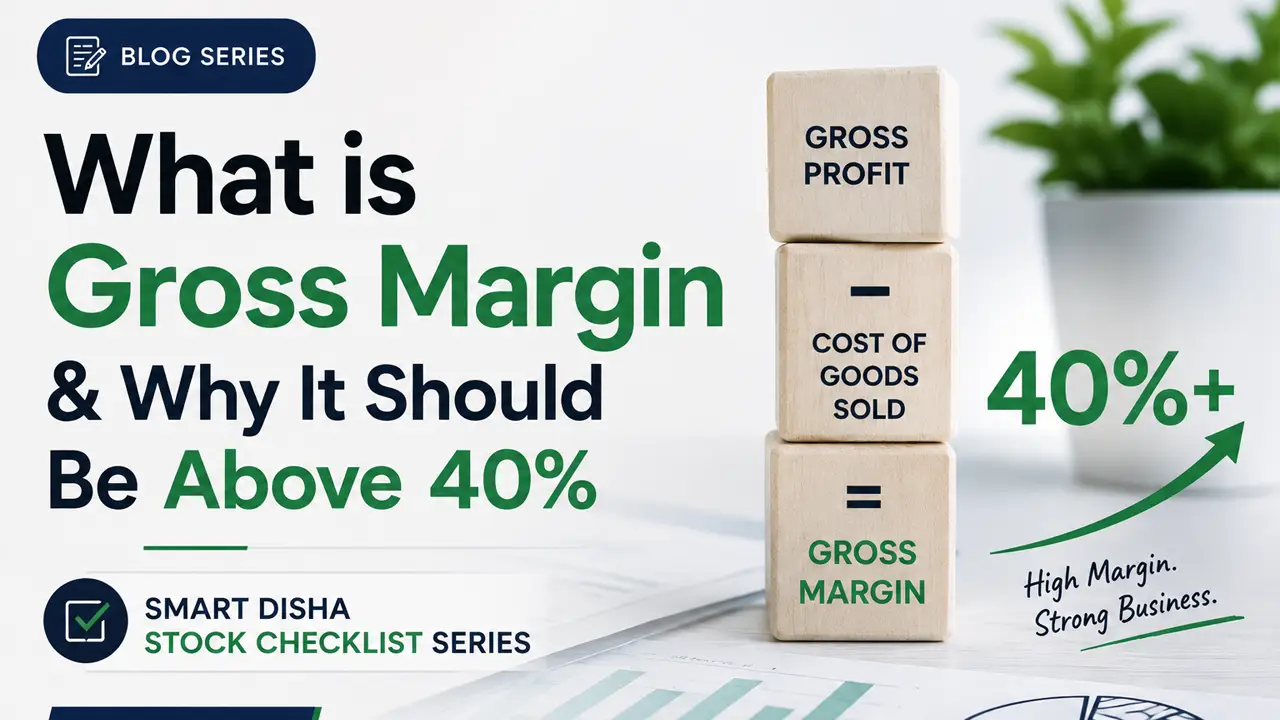
Gross margin in stocks is the percentage of revenue a company retains after paying the direct costs of producing its goods or services. In other words, it shows how much money is left from every rupee of sales before paying for salaries, marketing, rent, or taxes.
Formula:
Gross Margin (%) = [(Revenue – Cost of Goods Sold) / Revenue] x 100
To make this clearer, here is a simple example:
- A company earns Rs. 100 in sales
- It spends Rs. 55 to produce those goods (raw materials, manufacturing, labour)
- As a result, it is left with Rs. 45
- Therefore, Gross Margin = 45%
This Rs. 45 is what the company uses to pay for everything else. Consequently, a higher gross margin means more money available for growth, research, and ultimately profit for investors
Why Does Gross Margin in Stocks Matter So Much?
Gross margin in stocks is a direct reflection of a company’s pricing power and business model strength. Moreover, it is one of the hardest metrics to fake because it comes straight from the core economics of the business
Think of it this way. When a company consistently earns more than it spends on production, it means the market genuinely values what it is selling. Furthermore, that value does not disappear easily during tough economic cycles
A company with high gross margin can charge premium prices without losing customers. Its products or services are differentiated and therefore not easily copied by competitors. As a result, it enjoys a strong competitive moat that protects its business over the long term. Furthermore, when raw material costs rise, a high gross margin company has enough buffer to absorb the shock without sacrificing profitability
On the other hand, a company with low gross margin is competing primarily on price. Consequently, any increase in raw material costs flows directly into losses because there is simply no buffer to absorb it. Moreover, management has very little room to raise prices without risking customer loss to cheaper competitors
In short, gross margin in stocks tells you whether a business is built on genuine value or fragile pricing. Therefore, it is always the first number Smart Disha checks before anything else
Why Smart Disha Uses 40% as the Gross Margin Benchmark
At Smart Disha Academy, our stock checklist sets gross margin in stocks above 40% as the minimum benchmark. But why exactly 40%? Here is the reasoning behind it
First, a gross margin above 40% signals that the company has a genuine competitive advantage. It is not just a commodity business fighting for scraps. Instead, it has pricing power, brand value, or a proprietary product that allows it to earn significantly more than its cost of production
Second, companies below 40% are not automatically bad investments. However, they require much more careful analysis because they are more vulnerable to input cost shocks, rising competition, and economic slowdowns
Third, and most importantly, this benchmark has been used by some of the world’s most successful investors as a first filter when screening for quality businesses. As a result, it works equally well and consistently in the Indian market
Gross Margin in Stocks by Sector Indian Market Reference
Different industries naturally have very different gross margin profiles. Therefore, it is important to always compare gross margin within the same sector and never across different industries
| Sector | Typical Gross Margin | Notes |
| Software / IT Services | 60 to 80% | Very high, low input costs |
| Pharmaceuticals | 55 to 70% | Strong IP protection drives margins |
| FMCG (Branded) | 45 to 65% | Brand power equals pricing power |
| Banking / NBFC | 40 to 60% (NIM based) | Net Interest Margin used instead |
| Specialty Chemicals | 35 to 55% | Varies by product mix |
| Auto and Manufacturing | 15 to 30% | Capital intensive and competitive |
| Steel / Metals | 10 to 20% | Commodity, margins are thin |
| Retail / Trading | 10 to 25% | Low margin, high volume model |
Key Insight: If you are looking at a manufacturing or commodity company with gross margins below 20%, that business needs very high volume and perfect execution to remain profitable. Consequently, one bad quarter can destroy the entire year’s earnings
Real Indian Stock Examples – High vs Low Gross Margin in Stocks
To understand gross margin in stocks more concretely, let us look at real examples from the Indian market.
High Gross Margin Companies (Above 40%)
Asian Paints Asian Paints maintains gross margins consistently above 40%. Moreover, its strong brand, wide distribution network, and pricing power allow it to pass on raw material cost increases to consumers without losing market share. As a result, it continues to generate strong profits year after year even in volatile economic conditions
TCS (Tata Consultancy Services) TCS operates with gross margins in the 60 to 70% range. Since IT services companies sell intellectual capital and not physical goods, their input costs remain very low. Consequently, these companies generate enormous profits relative to their revenue. This is the clearest example of why gross margin in stocks matters so much
HDFC Bank Although banks use Net Interest Margin (NIM) instead of traditional gross margin, HDFC Bank consistently maintains NIM above 4%. This indicates strong pricing power in its lending products, which is exactly the characteristic that high gross margin reveals in other industries
Low Gross Margin Companies (Below 20%)
Tata Steel As a commodity business, steel margins are thin and heavily dependent on global iron ore and coal prices. The company is not necessarily a bad investment. However, it requires a completely different analysis framework, one that goes far beyond gross margin alone
ONGC Oil and Gas companies operate on thin refining margins. Furthermore, their profitability is primarily driven by crude oil prices, a global factor they cannot control. As a result, these companies are highly cyclical and carry significant commodity risk
Smart Disha Insight: Low gross margin is not always a dealbreaker but it is always a warning signal that demands deeper investigation before investing
How to Find Gross Margin in Stocks Step by Step
Finding gross margin data is straightforward for any Indian listed company. Here is exactly how to do it:
1: Go to Screener.in or Tickertape.in and search for the company by name or ticker symbol
2: Open the Financials tab and look for Revenue from Operations and Cost of Goods Sold or Cost of Materials Consumed
3: Apply the formula: (Revenue – COGS) / Revenue x 100 = Gross Margin %
4: Check the trend over 5 years. A consistently high or improving gross margin is far more meaningful than a single year’s number
FAQs
Q1. What is gross margin in stocks and why does it matter?
Gross margin in stocks is the percentage of revenue a company keeps after paying direct production costs. It matters because it directly reflects pricing power and business quality. A high gross margin means the company has a competitive moat and can raise prices, absorb cost shocks, and generate strong profits consistently over time
Q2. Why should gross margin in stocks be above 40%?
A gross margin above 40% indicates a genuine competitive advantage such as pricing power, brand value, or a proprietary product. Below this level, companies are more vulnerable to raw material cost increases and competitive pricing pressure. However, always compare within the same sector as benchmarks differ by industry
Q3. Is gross margin the same as net profit margin?
No, they are different. Gross margin measures profit after deducting only direct production costs. Net profit margin, on the other hand, measures final profit after all expenses including operating costs, interest, and taxes. Therefore, gross margin is always higher than net profit margin. We cover net profit margin in detail in Part 3 of this series
Q4. Which Indian sectors have the highest gross margins in stocks?
IT and Software services (60 to 80%), Pharmaceuticals (55 to 70%), and branded FMCG companies (45 to 65%) consistently show the highest gross margins in Indian stocks. These sectors benefit from intellectual property, strong brand value, and low raw material dependency, which is exactly why they are quality long-term investments
Q5. What does it mean if gross margin is falling every year?
A consistently declining gross margin is a serious red flag. It means the company is losing pricing power, facing rising input costs it cannot pass on to customers, or losing market share to competitors. As a result, this requires immediate deeper investigation before making any investment decision in that stock
Conclusion
Gross margin in stocks is the foundation of fundamental stock analysis. First and foremost, a company with gross margin consistently above 40% has a genuine competitive moat. It can price its products well, absorb cost shocks, and generate enough profit to grow and reward investors over the long term
That is precisely why gross margin in stocks above 40% is the very first checkpoint in Smart Disha’s Checklist for a Good Stock Company
However, gross margin is only the first layer of analysis. To truly understand whether a company is worth investing in, you need to go one level deeper into how efficiently the company converts that gross profit into actual operating profit. Moreover, that number reveals whether the management is running the business efficiently or letting costs eat away at the margins
That is exactly what we cover next. Read Part 2: What is Operating Margin in Stocks and Why It Should Be Above 20% to continue building your fundamental analysis checklist one powerful metric at a time
 SEBI Registered Research Analyst