
In Part 1 of this series, we learned that gross margin in stocks above 40% is the first green flag of a quality business. However, a high gross margin alone is not enough. A company can earn strong gross profits and still lose money if it is spending too heavily on salaries, advertising, and administration
That is exactly where operating margin in stocks becomes critical
Operating margin in stocks is the second checkpoint in Smart Disha’s Checklist for a Good Stock Company. Moreover, it is arguably the most revealing metric on the entire income statement because it tells you something gross margin cannot. It shows whether the company’s management is actually running the business efficiently
In this article, which is Part 2 of our 5-part Income Statement Series, we break down what operating margin in stocks means, why it must be above 20%, and how to use it to find well-run companies in the Indian market
What is Operating Margin in Stocks?
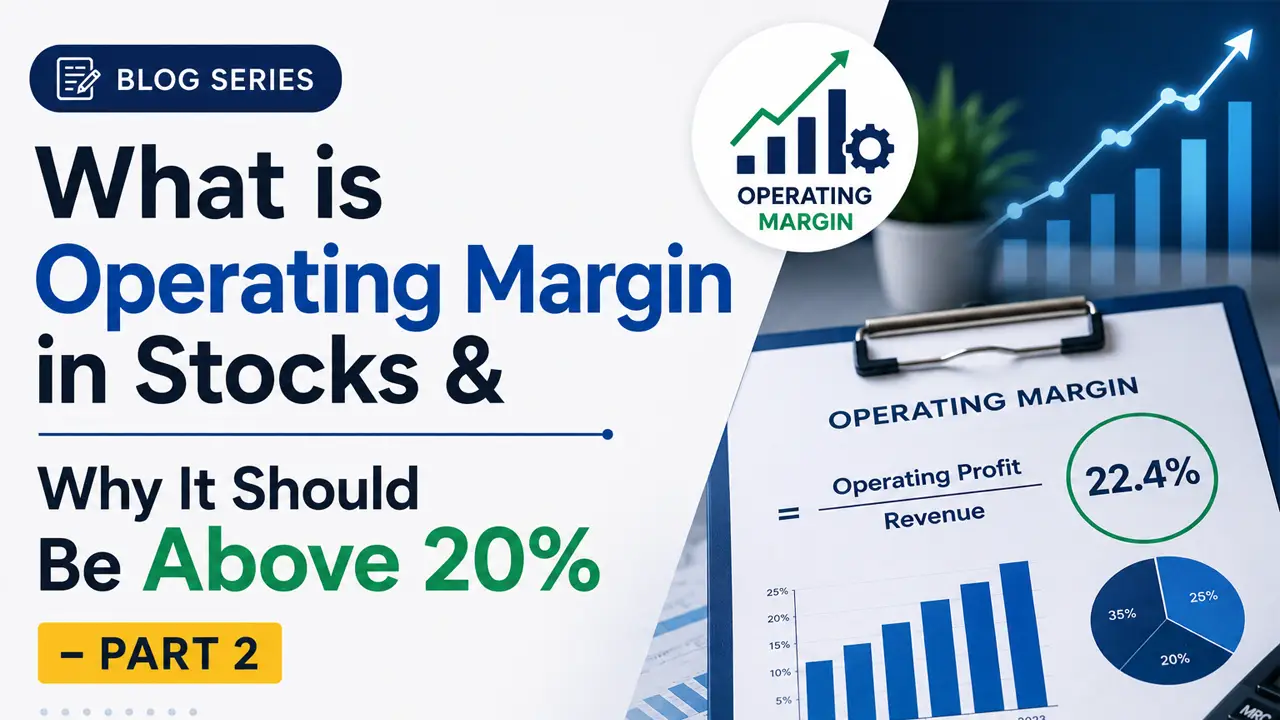
Operating margin in stocks is the percentage of revenue a company retains after paying all operating expenses including salaries, rent, utilities, marketing, and administration, but before paying interest and taxes
Formula:
Operating Margin (%) = [Operating Profit (EBIT) / Revenue] x 100
Here is a simple example to make it clear:
- Revenue: Rs. 100
- Cost of goods sold: Rs. 55, leaving Gross Profit of Rs. 45
- Operating expenses including salaries, rent, and marketing: Rs. 20
- Therefore, Operating Profit = Rs. 25
- Operating Margin = 25%
This Rs. 25 is what remains before paying interest and taxes. Consequently, the higher this number, the more efficiently the business is being run.
Operating Margin vs Gross Margin Key Difference
Since we covered gross margin in Part 1, it is important to understand exactly how these two metrics differ from each other.
| Gross Margin | Operating Margin | |
| What it reveals | Product strength and pricing power | Management efficiency and cost control |
| Expenses included | Raw materials and manufacturing | Plus salaries, rent, marketing, and admin |
| Smart Disha benchmark | Above 40% | Above 20% |
In short, gross margin tells you about the quality of the product. Operating margin, on the other hand, tells you about the quality of the management. Together, both give you a far more complete picture of overall business quality
Why Operating Margin in Stocks Must Be Above 20%
At Smart Disha Academy, we set operating margin in stocks above 20% as the benchmark. Here is the reasoning behind this number
First, a company with operating margin above 20% retains at least Rs. 20 from every Rs. 100 of revenue after running its entire business. This is a strong sign of cost discipline and operational efficiency
Second, and most importantly, companies above 20% typically enjoy operating leverage. This means profits grow even faster than revenue as the business scales. Consequently, these companies tend to create significant shareholder wealth over long periods of time
Third, companies with margins consistently above 20% handle economic downturns far better. When revenues fall during a tough cycle, they still have enough buffer to remain profitable. However, companies operating at 5 to 8% margins quickly slip into losses when business slows down
Operating Margin in Stocks by Sector Indian Market Reference
| Sector | Typical Operating Margin |
| Software / IT Services | 20 to 35% |
| Pharmaceuticals | 18 to 28% |
| FMCG (Branded) | 15 to 25% |
| Specialty Chemicals | 15 to 25% |
| Auto and Manufacturing | 8 to 15% |
| Steel / Metals | 8 to 18% |
| Retail / Trading | 3 to 10% |
Therefore, always compare operating margin within the same sector and never across different industries
Real Indian Stock Examples – Operating Margin in Stocks
Infosys – 20 to 23% operating margin Infosys consistently maintains operating margins above 20% and actively guides investors on its target margin range every quarter. Moreover, this consistency over many years is exactly what a well-managed, high-quality IT business looks like in practice
Hindustan Unilever (HUL) – 22 to 25% Despite heavy advertising spend, HUL maintains strong operating margins year after year. Furthermore, its brand portfolio gives it pricing power to protect margins even when input costs rise. This is a hallmark of a genuinely quality FMCG business
Tata Motors (Domestic) – 5 to 8% High fixed manufacturing costs and intense competition keep Tata Motors’ domestic operating margins under pressure. As a result, this business requires a very different analysis framework compared to high-margin companies
Smart Disha Insight: When you find a company with gross margin above 40% and operating margin above 20%, you are looking at a genuinely high-quality business. This combination is one of the most powerful filters in all of fundamental analysis
How to Find Operating Margin in Stocks
Finding this data for any Indian company is simple and straightforward:
- Go to Screener.in or Tickertape.in
- Search for the company and open the Financials tab
- Find EBIT (Operating Profit) and divide by Revenue
- Check the 5-year trend because consistency matters more than a single year
- Compare with industry peers because higher than peers signals a competitive advantage
FAQs
Q1. What is a good operating margin for Indian stocks?
For most sectors, above 20% is considered strong. However, benchmarks differ by industry. IT companies typically achieve 20 to 35%, while manufacturing companies operate at 8 to 15%. Therefore, always compare within the same sector for a meaningful and accurate evaluation
Q2. What does a falling operating margin mean?
If gross margin is stable but operating margin is falling, it means operating costs such as salaries, marketing, and administration are rising faster than revenue. Consequently, management is losing cost control. This is a serious red flag that demands investigation before investing in that stock
Q3. Is operating margin better than net profit margin for stock analysis?
Both are important, but operating margin is often more useful for comparing companies because it excludes interest and taxes, which vary based on debt levels and tax structures. Moreover, it directly reflects core business efficiency. We cover net profit margin in full detail in Part 3 of this series
Q4. How is operating margin related to operating leverage?
Companies with high operating margins benefit from operating leverage. As revenue grows, fixed costs stay largely constant, so profits grow even faster than revenue. As a result, high operating margin companies tend to be exceptional long-term wealth creators in the Indian market
Q5. Can a company have high gross margin but low operating margin?
Yes, and this is an important warning signal. It means the company’s product is strong but management is spending excessively on salaries, marketing, or administration. Furthermore, this gap between gross margin and operating margin directly reveals whether cost discipline exists at the operational level. Therefore, always check both metrics together before making any investment decision
Conclusion
Operating margin in stocks above 20% is proof that a company’s management is running the business with discipline and efficiency. Furthermore, when combined with gross margin above 40% from Part 1, this metric powerfully narrows your stock universe down to only the highest-quality businesses in the Indian market
However, strong gross and operating margins still do not tell the full story. Moreover, a company must also convert those profits cleanly into actual earnings for shareholders. That is exactly what the next metric reveals
Continue with Part 3: What is Net Profit Margin in Stocks and Why It Should Be Above 15% to complete the profitability layer of your analysis
Missed the beginning? Read Part 1: What is Gross Margin in Stocks and Why It Should Be Above 40% first
 SEBI Registered Research Analyst